
Developing the Climate Health Explorer Toolkit
The WM-Net Zero project is introducing an innovative tool called the Climate Health Explorer to assess the impacts of climate policies on non-communicable diseases (NCDs) and mental health in the West Midlands. This toolkit is designed to go beyond the typical focus on air quality by evaluating multiple environmental exposure pathways that influence health across the lifespan. Using local and regional data, the Climate Health Explorer will provide a comprehensive systems-based approach to understanding how climate policies affect health in our communities.
The toolkit integrates three advanced components:
- Participatory Systems Mapping (PSM) Toolkit: This guides engaging stakeholders in developing systems maps, helping to visualize the complex relationships between climate actions and health outcomes.
- Environmental Modelling Tool: By using detailed emissions data, this tool models the distribution of air pollutants across different areas, down to a 10m resolution for specific local activities like traffic. This allows for high-resolution environmental predictions and future projections based on regional and global scenarios.
- Health Economic Modelling Tool: Building on the open-source Air-Quality Life-course Assessment Toolkit (AQ-LAT), this component assesses the effects of climate policies on various health outcomes and economic costs. It considers healthcare demands, lifestyle factors, and economic impacts at the local level, allowing for equity analysis across different communities.
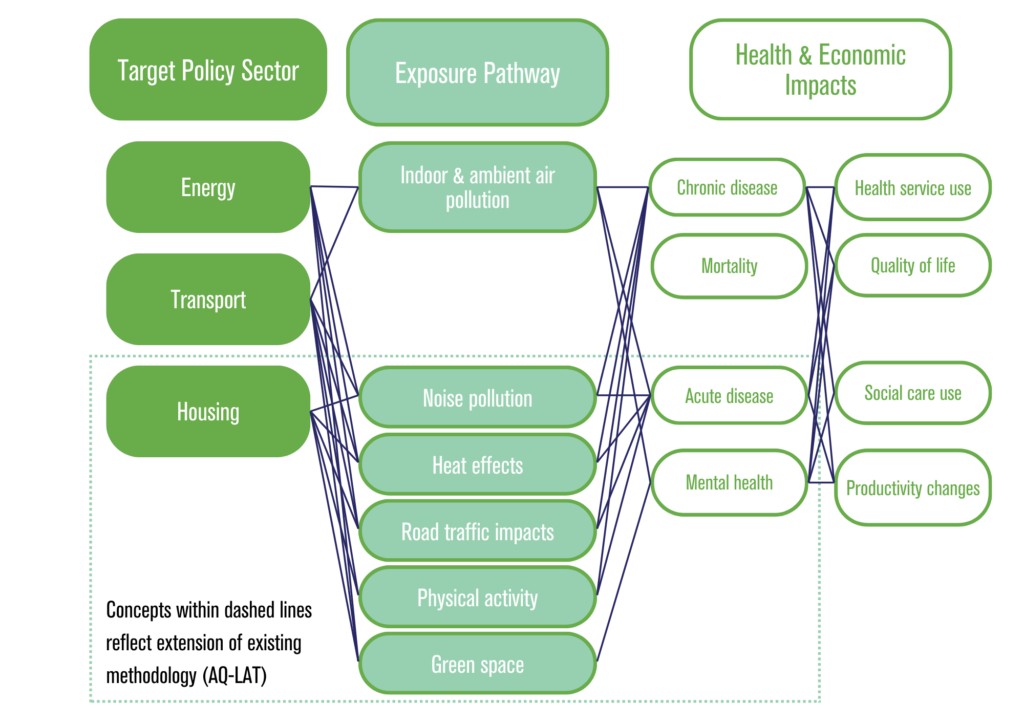
Through the Climate Health Explorer, the WM-Net Zero project aims to provide local authorities and health services with actionable insights, ensuring that climate policies deliver health benefits equitably across different populations. This toolkit will enable a deeper understanding of how Net Zero policies impact both health and economic outcomes, guiding effective and inclusive policy development.
Launched on 4 June 2026, the Climate Health Explorer webinar introduced the toolkit, demonstrated its key features, and explored how local and regional data can support evidence-informed decision-making across sectors including public health, local government, housing, transport, and the voluntary sector.
During the session, attendees heard from members of the project team and regional experts about the links between climate change, health, and economic resilience, and how the Explorer can be used to investigate the potential impacts of different climate actions and policy scenarios.
Watch the recording
Watch the full webinar recording here:
Explore the Climate Health Explorer
The Explorer allows users to:
- Explore climate and health data across the West Midlands
- Understand how climate risks affect health and wellbeing
- Examine the links between transport, air quality, and health outcomes
- Explore the potential health and economic impacts of climate action
- Support planning, policy development, and investment decisions using local evidence
Access the Climate Health Explorer:

Dr Suzanne Bartington
- Institute of Applied Health Research
Clinical Associate Professor in Environmental Health
UKRI Clean Air Champion